
What is a SSAS Pension?
- Director-only pension with full investment control and pension tax benefits.
- Powerful tool for business funding, commercial property investment, and succession planning.
- Designed for tax efficiency, flexibility, and long-term wealth control.
A strategic pension for directors and business owners
A Small Self-Administered Scheme pension (SSAS) is a pension scheme, exclusively for company directors. It is a unique and flexible property and occupational pension scheme, specifically created under legislation for company directors in the UK. If you set up a SSAS pension, you have full access to every type of investment available to SSAS investors according to the rules set out by HMRC. A SSAS fund benefits from all the same tax relief and advantages as a traditional personal pension, such as a tax-free lump sum of 25%, capped by the lump sum allowance of £268,275, available from age 55 and rising to 57 on 6 April 2028, new contributions of up to £60,000 a year and flexible drawdown.
There are several different investment options available when using a SSAS, but for business owners, this type of pension scheme is also beneficial for investing in commercial property or raising funds for any other aspect of running a company. For family businesses, the SSAS offers great benefits for tax efficiency, succession planning, and business continuity.
The ability to loan to the company using the SSAS loanback facility is especially useful when looking for business funding, cashflow or tax efficiency for the business.
If you are a UK company director looking for an efficient and flexible occupational pension scheme, it is worth exploring a SSAS pension.
A SSAS is a good idea for those looking to build a legacy, grow their business, save tax, protect wealth, invest and diversify their pension funds and generally take control, with ultimate flexibility.

Tax Relief on Contributions
Contributions to the SSAS also receive tax relief (provided some conditions are met). This makes it a powerful tool for reducing your tax liability while building retirement wealth
Key Benefits
- Invest in property
- No upfront fees
- Investment returns
- Loan to company
- Consolidate pensions
- Reduce pension charges
What does SSAS stand for?
SSAS stands for Small Self-Administered Scheme. It is a type of occupational pension scheme established by a company for its directors - not a personal pension, but a company scheme. That distinction matters: because a SSAS is a company arrangement rather than a personal one, it can hold company assets, lend to the sponsoring business, and be structured to support succession planning across generations. It is this company-scheme status that separates a SSAS from a SIPP and gives it its most powerful features.
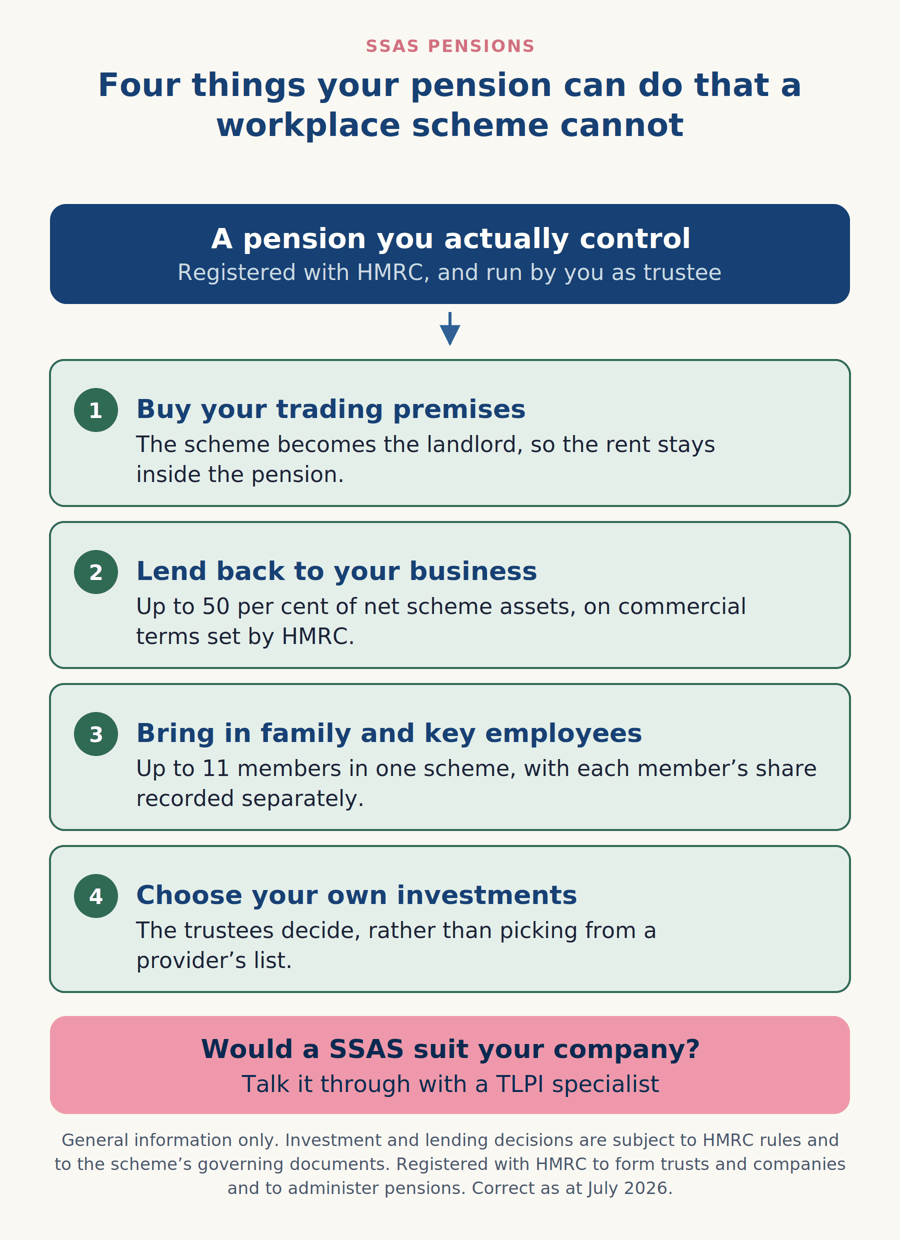
The diagram below sets out what a SSAS makes possible that an ordinary workplace pension does not.
Who can have a SSAS pension?
A SSAS is available to directors and controlling shareholders of UK limited companies. Most schemes allow up to 11 members, typically the directors and senior employees of a single company and/or family members. There is no minimum contribution - but to make the most of the investment freedoms a SSAS offers, most members are contributing £50,000 or more per year.
SSAS vs SIPP: which is better for company directors?
For a sole trader or employee, a SIPP is often the right choice. For a company director who wants to use their pension for business purposes - lending to the company, buying the trading premises, or building wealth tax-efficiently alongside Corporation Tax planning - a SSAS is almost always more powerful.
- A SSAS is established by the company; a SIPP is a personal arrangement
- A SSAS can lend up to 50% of the fund's value back to the sponsoring company
- A SSAS can hold commercial property, including the company's own trading premises
- A SSAS allows collective investment decisions across all members of the scheme
- A SIPP is simpler to set up and may suit lower contribution levels or those without a limited company
Should I set up a SSAS?
A SSAS is a powerful structure, but it is not the right starting point for every company director. It suits a particular set of circumstances, and being honest about which ones tends to save a great deal of time.
When a SSAS tends to make sense
Your company is consistently profitable. The central benefit of employer contributions is Corporation Tax relief, and relief is only worth something against tax you are actually paying.
You want the money to keep working rather than simply leave the business. A SSAS can hold commercial property, including the premises your own company trades from, and it can lend back to the sponsoring employer within HMRC conditions. See the Property SSAS.
You are comfortable with the money being committed for the long term. Pension funds are not accessible until the normal minimum pension age, currently 55 and rising to 57 on 6 April 2028.
You have existing pensions worth bringing together. Consolidating older workplace and personal pensions into one SSAS increases the fund available to invest and reduces the number of separate charges.
You are willing to act as a trustee. SSAS members are usually trustees. That is what gives you control, and it is a genuine responsibility rather than a formality.
When a SSAS is probably premature
Your profits are not yet consistent. If the company is early stage, pre-profit, or has had a difficult year, the Corporation Tax relief has little to work against.
You need the cash in the business in the near term. The loanback facility exists, but it operates within HMRC limits and is not a substitute for working capital.
You are already drawing flexibly from another pension. Once benefits have been flexibly accessed, the MPAA restricts future money purchase contributions to £10,000 a year.
You are looking for a way to hold residential property. A SSAS cannot hold residential property without triggering unauthorised payment and scheme sanction charges under HMRC taxable property rules.
You want a structure for post-tax surplus rather than pre-tax profit. That is a different problem, and a Family Investment Company is usually the better fit. The two are frequently used together.
Whether a SSAS is right for your company depends on your profit position, your plans for the business, and what you already have in place. TLPI is a tax planning and pension specialist. Holtram TLPI Ltd is registered with HMRC to form trusts, companies and to administer pensions, so we will set out the position and the options rather than tell you what to do with your pension.
A free, no-obligation call to discuss your SSAS pension options.